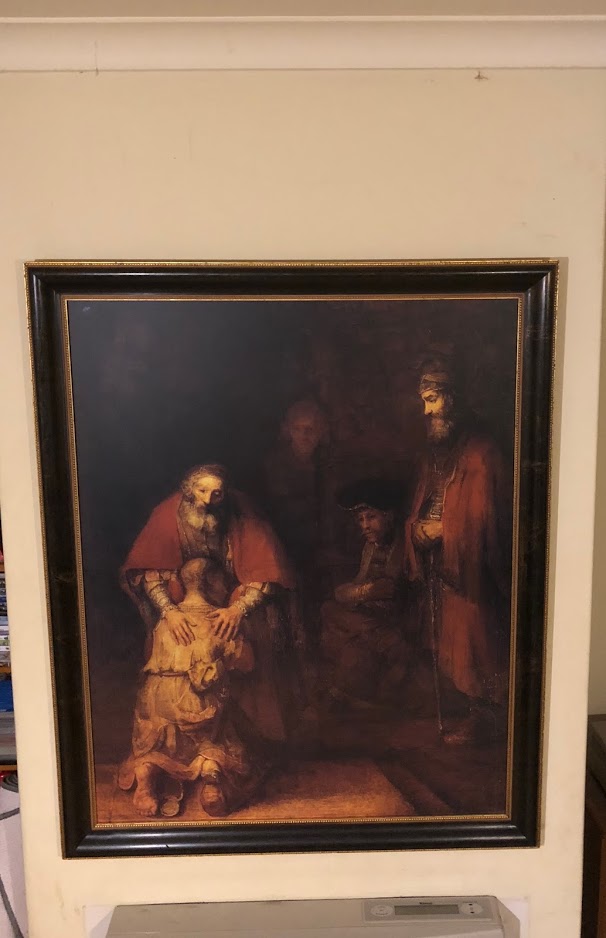
When I was on holidays twenty years ago or so I read a copy of Henri Nouwen’s book Return Of The Prodigal Son.
It’s a shortish monograph of Nouwen’s reflections arising from an extended viewing of the Rembrandt painting inspired by that biblical scene.
The original hangs in the The Hermitage in Russia, measuring an imposing 262 cm × 205 cm
I came home and bought a poster print of the painting that measures about 130 cm x 100 cm or so.
One thing led to another and it seemed a good idea to get the poster framed to protect my investment.
The local framing guy in Mordialloc said he had an ideal material for a suitable frame.
The frame ended up costing more than the poster, but it has given me immense pleasure for a long time.
One thing led to another and it was time to replace the glass in the frame.
Crossing off yet another of my list of things that have annoyed me / been left undone for too long, local business Framing Solutions fitted Ultra Clear glass and brought it back home again.
There is so much detail hiding in the painting for the patient and reflective viewer, and now more able to be seen.
More pleasure.
Fonts In Use is “An independent archive of typography”.
The website is an archive of photographs of all sorts of items, each photo accompanied by an identification of the particular fonts which feature in its design.
Tagged by industries, formats, and typefaces each featured item has a page that states something about the history of the item or product and the fonts used as part of its production.
It’s interesting to get some ideas for fonts and what sort of fonts are used together in various products.
Want to know what type face is used on a product, show or book?
This is the place.
A design haven.
Go visit.

Everyone is used to (but nobody likes) the way that petrol prices rise and fall through the week in a way that has less to do with the cost of production and more to do with increased demand and capacity to pay.
In Australia most mortgages have interest rates that can be raised (and more recently lowered) with no or little notice.
But the same grudging tolerance is not extended towards other products.
This Today I Found Out Story made me think of that.
It’s about a time when Coca-Cola trialled vending machines that had internal thermostats so that they could raise or lower their prices based on what would be understood to be people’s thirst.
It did not prove to be a popular measure.
Perhaps it was simply before its time.
(When I used to drink soft-drink there was a vending machine that sold Coke Zero cheaper than anywhere else and I went out of my way to use it.)
A brief excerpt.

When asked how Coca-Cola as a company planned to take advantage of the amazing revelation that hot weather inexplicably also coincided with an increased demand for cold drinks, Ivester stated that they’d been developing a new line of vending machines that exploited this fact. Specifically, [then CEO Doug] Ivester explained that Coca-Cola had been experimenting with vending machines that contained a thermostat and simple software that would raise the price of the products within the machine once a certain temperature threshold had been reached. As Ivester himself would correctly point out during the interview, neither the technology nor the idea of raising the price of a product in times of great demand was a new concept, noting in regards to the latter that “the machine will simply make this process automatic”.

Read the whole article at Today I Found Out.