Heidelberg Catechism – Lord’s Day 45

116.
Q. Why is prayer necessary for Christians?
A. Because it is the chief part of the gratitude which God requires of us, and because God will give his grace and Holy Spirit only to those who sincerely beseech him in prayer without ceasing, and who thank him for these gifts.

117.
Q. What is contained in a prayer which pleases God and is heard by him?
A. First, that we sincerely call upon the one true God, who has revealed himself to us in his Word, for all that he has commanded us to ask of him. Then, that we thoroughly acknowledge our need and evil condition so that we may humble ourselves in the presence of his majesty. Third, that we rest assured that, in spite of our unworthiness, he will certainly hear our prayer for the sake of Christ our Lord, as he has promised us in his Word.

118.
Q. What has God commanded us to ask of him?
A. All things necessary for soul and body which Christ the Lord has included in the prayer which he himself taught us.

119.
Q. What is the Lord’s Prayer?
A. “Our Father in heaven, hallowed be your name. Your kingdom come, your will be done, on earth as it is in heaven. Give us this day our daily bread, and forgive us our debts, as we also have forgiven our debtors. And lead us not into temptation, but deliver us from evil. For yours is the kingdom and the power and the glory, forever. Amen”
Brian Croft writes about the virtues of silence in a noisy and distracted world.
It is a practice that Christians exercise before God, and one that we then exercise toward one another, so that we might truly listen.
Croft explains how silence enables us to listen, not just wait for our turn to make noise.

Silence Teaches Us to Listen
I was deeply troubled to learn that I had been a pastor for so long, and yet remained a poor listener. Sure, I listened, but it was mostly to prepare a response. I needed to learn to listen without needing to respond—just to listen and empathize.
As I embraced silence, I realized I was learning to listen. I heard sounds around me I never noticed before. I felt more receptive to God’s Word. It’s amazing what happens when you’re not preoccupied with trying to figure out what to say or do next.

Read the rest of Croft’s post here.

Every human disappearing would be catastrophic for humans.
What about everything else?
This video has a crack at explaining.
(I sometimes think I wouldn’t mind giving it a go, but this does point out that my go wouldn’t last very long at all.)

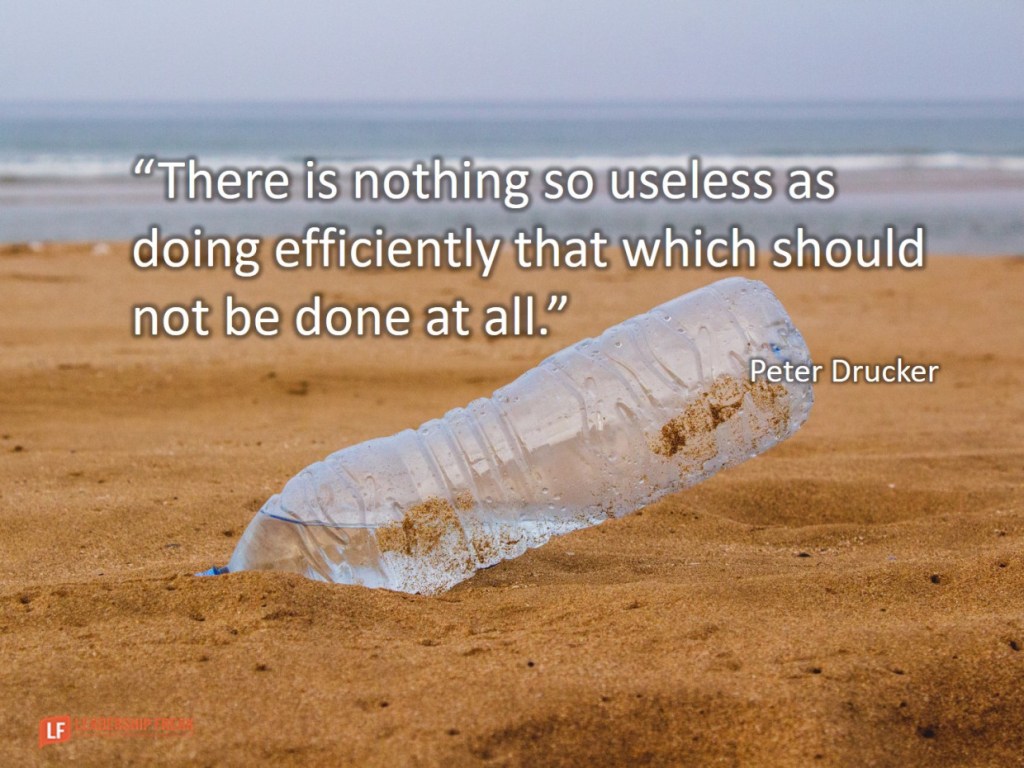
It was mostly this quote from Peter Drucker that pulled me up:
“There is nothing so useless as doing efficiently that which should not be done at all.”

Dan Rockwell always value adds though and points out some helpful ways of identifying what the problem actually is, so that you can then invest time and energy into trying to create effective solutions.

Read more at Leadership Freak.