Twenty years ago today I met with a church and preached a sermon in a town in country South Australia. Things went okay. Where does the time go?

Twenty years ago today I met with a church and preached a sermon in a town in country South Australia. Things went okay. Where does the time go?
We engage with classic texts from the past not so they slavishly define our present, nor so to judge and dismiss them from contemporary standards.
Instead, these texts are heard and the considered response we make is at once informed by them and seeks to move on from them.
Engaging with these alien texts provides us with an opportunity to grow that cannot be present if all we take on board is simply the restatement of our current points of view and biases.
These observations about the Biblical patriarch Jacob are removed from some specific context, but I like them as observations about Jacob, and about his struggle with a power he knows he cannot prevail against, a power he believes will be benevolent toward him.
…Jacob, in the book of Genesis, who, by the side of a stream called Jabbok, all through the night, wrestles with “a man.” They grapple for hours, and then, as the sun rises, the man has had enough, but Jacob says to him, “I will not let you go until you bless me.” Jacob later says that it was God he wrestled with, but hat is a rather demanding attitude to take toward a deity, is it not? But note what Jacob demands. Indeed, to think that struggle and demand are incompatible with reverence is perhaps to misunderstand what reverence is – even what authority itself is.
+++
…Jacob, who wrestled with a mighty figure by the Jabbok not in order to defeat or destroy him, but with a strange generosity, an eager and earnest belief that his opponent had something of great value in his possession, and that he could give it to Jacob. I will not let you go until you bless me.Alan Jacobs, Breaking Bread With The Dead, Profile Books, 2020, pgs 87-88, 90
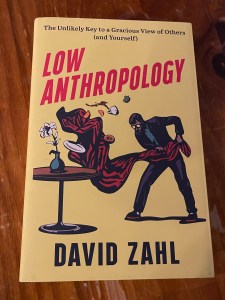
The high anthropology of our age trains us to think of ourselves as unique, while our online activity is relentlessly mined and analysed in order to define how we’re exactly like so many others.
The same online portals who flatter us as unlike anyone else follow all our movements and work out how to market to our desires of the moment by comparing us with others in real time.
They attract us with the high anthropology of our uniqueness and our ability to engineer a perfect life; yet they process the data they receive with the low anthropological view that we’re really all alike, and our desires will never be satisfied.
Today, the “uncanny ad” is commonplace. You read some grill reviews on Amazon one night, and the next time you log into Facebook, postings for wireless cooking thermometers and small-batch BBQ sauce are clogging your feed. Other times it’s more subtle. You haven’t even announced your engagement to be married yet. but your patterns of purchases fit the mod, so the airlines are pitching you honeymoon flights before you’ve told your parents.
Experiences like these are endemic to the age of the algorithm, a time increasingly ruled by those complex codes that order our experience of the internet. Now companies know so much about their customers they have to be careful to avoid public-relations snafus… Algorithms work only because, despite how loudly we may insist on our uniqueness, we are a predictable species.David Zahl, Low Anthropology, Brazos Press, 2022, pg 44.
Where We’ll Never Grow Old.
The older I get, the more of a comfort that is.
James C. Moore wrote the words and music over 100 years ago.
The lyrics:
1.
I have heard of a land
On the faraway strand,
’Tis a beautiful home of the soul;
Built by Jesus on high,
There we never shall die,
’Tis a land where we never grow old.
Refrain:
Never grow old,
Where we’ll never grow old,
In a land where we’ll never grow old;
Never grow old,
Where we’ll never grow old,
In a land where we’ll never grow old.
2
In that beautiful home
Where we’ll nevermore roam,
We shall be in the sweet by and by;
Happy praise to the King
Through eternity sing,
’Tis a land where we never shall die.
Refrain
3
When our work here is done
And the life crown is won,
And our troubles and trials are o’er,
All our sorrows will end,
And our voices will blend
With the loved ones who’ve gone on before.
Refrain
 mgpcpastor's blog