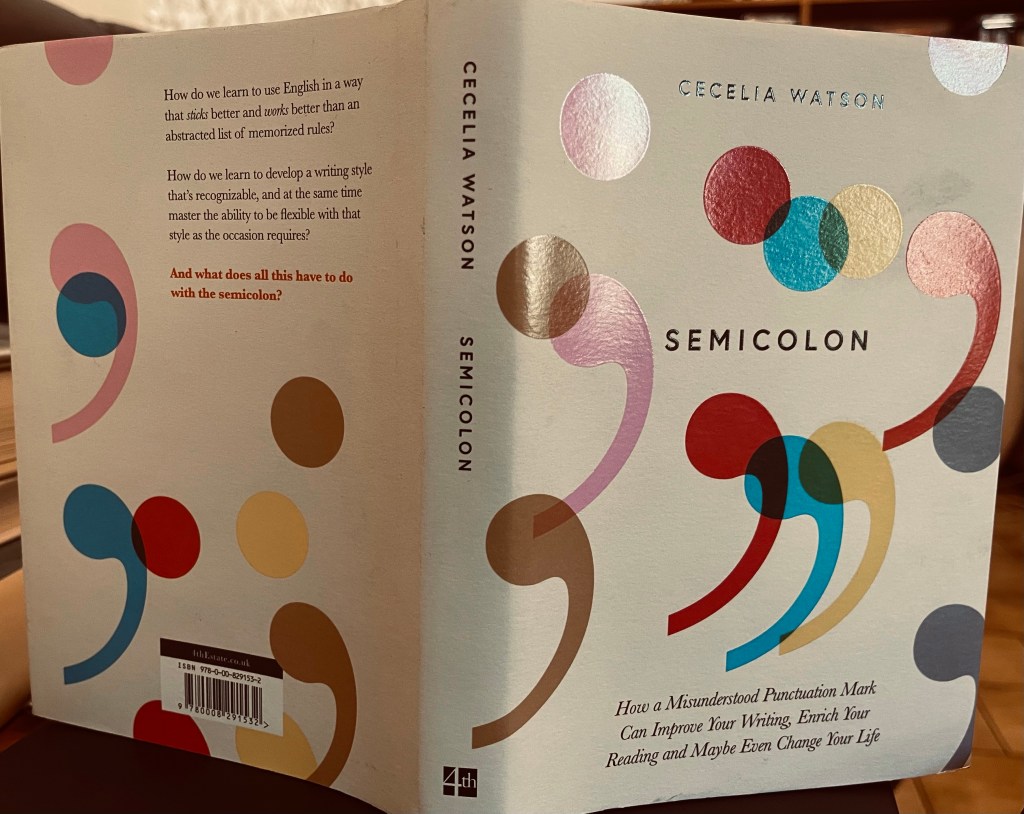
In its early usage the semicolon served as a pause twice as long as a comma, and half as long as a colon.
Eventually an adjustment in usage became identified by grammarians.
In Semicolon, Cecelia Watson explains:
The semicolon had been transformed. Before the 1800s, it had been a pause. By the early 1800s, grammarians began to describe these pauses as means to delineate clauses properly, such that punctuation served syntax, with its prosodic and musical features secondary.
Instead of a longer pause in a single expression, the semicolon because a pause that indicates there are two distinct but dependent aspects of an expression.
Apart from the utilitarian conformity for printers of having common symbols and forms of expression for their productions, grammar became in the eighteenth and nineteenth century a science, a common shared body of knowledge.
It also became a science in terms of individuals who sought to popularise systems of their own devising, the use of which would enable language to be broken into parts, and for those parts to be identified and catalogued.
In Semicolon, Cecelia Watson observes:
… grammarians answered to complaints about grammar’s relative dullness and uselessness with rather ingenious rhetoric: grammar, they proposed, was a method of teaching students the art of scientific observation without requiring expensive or complex scientific apparatus. In service of this goal of teaching scientific skills, grammarians resolved to employ careful observation of English, because this gave them a way to use the methods of science to refine grammar; and they imported into their grammars some of the conventions of science textbooks, such as diagrams.
Which reminded me of the scene from the movie Dead Poets Society where John Keating and his class engage with the work of J Evans Pritchard on the science of poetic appreciation.
If this YouTube clip disappears I’m sure you can look up another version.
“We’re not laying pipe! We’re talking about poetry.”
A very, very helpful post on Leadership Freak by Dan Rockwell.
Helping should be an innate aspect of life as a follower of Jesus.
Rockwell observes that “The goal of helping is enabling, not more helping.”
We should be helpers, and not ignore those in need, particularly those we have particular responsibility for.
But before stepping in constructive help never offers help “until you ask, “What have you tried?”
Useful helps “people find meaning in difficulty.”
This can assist them in developing the perspective by which they can lean into challenging situations in ways that grow resilience and competency, rather than cement a sense of inadequacy and dependence.
Cecelia Watson, in her book Semicolon, references some innovations in punctuation that did not catch on.
An example is the punctus percontativus, or rhetorical question mark. Using the symbol of a reversed question mark, it indicated that the question it preceded was rhetorical in intent.
In a piece of writing that I enjoyed, Watson descriptively demonstrates why some innovations, such as the semicolon, continued in written and printed works, while others fell by the wayside.
“The rhetorical question mark, on the other hand, faltered and then fizzled out completely. This isn’t too surprising: does anyone need a special punctuation mark to know when a question is rhetorical?”