I’m just a creature of habit.
The problem is all my habits share a common trait.
It’s been two months since a Poorly Drawn Lines post.
It’s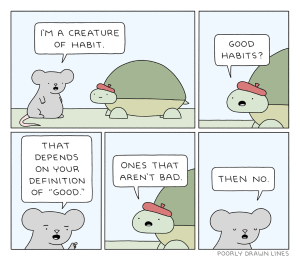 been an effort.

I’m just a creature of habit.
The problem is all my habits share a common trait.
It’s been two months since a Poorly Drawn Lines post.
It’s been an effort.
Those who nurture and lead a community based on grace and forgiveness can find themselves distanced from those very qualities in their own spiritual life.
The openness, vulnerability, and honesty encouraged in disciples of Jesus can be seen as liabilities for leaders.
When leaders don’t meaningfully engage in grace and forgiveness themselves their message becomes less Gospel and more spiritual theoretical process.
And when they are exposed to prolonged denial of the peace, security, and relationship which grace and forgiveness provide, they will find themselves looking for gratification, meaning, and intimacy through other, harmful, means.
When spirituality becomes spiritualisation, life in the body becomes carnality. When ministers and priests live their ministry mostly in their heads and relate to the Gospel as a set of valuable ideas to be announced, the body quickly takes revenge by screaming loudly for affection and intimacy. Christian leaders are called to live the Incarnation, that is, to live in the body, not only in their own bodies but also in the corporate body of the community, and to discover there the presence of the Holy Spirit.
Henri J. M. Nouwen, In The Name Of Jesus – Reflections On Christian Leadership, The Crossroad Publishing Company NY, 1989, pgs. 67-68.

My trial of Apple Music must be transitioning to something I’m paying for sooner or later (if that hasn’t happened already).
It keeps throwing up interesting selections to follow on from whatever I start playing.
Another Soul Free started playing last week.
It’s the sort of song I really like.
I could imagine singing this with a congregation.
Probably with the outro. Definitely without the outro.
I don’t know anything at all about the song’s composer Ernstly Etienne.
The lyrics:
Refrain.
I’ve got a song in my heart
I’ve got a praise in my feet
I’ve got a hallelujah rising inside of me
If I’ve got breath in my lungs
Then you’re not finished with me
So let my soul’s salvation
Set another soul free
Verse 1
As long as I’m alive
I’ll freely testify
The mercy of our God
Healed my heart and saved my life
I once was dead in sin
Now I’m walking in the light
Praise God
Praise God
Praise God
Refrain.
Verse 2
As long as I’m alive
I’ll freely testify
The mercy of our God
Healed my heart and saved my life
I once was dead in sin
Now I’m walking in the light
Praise God
Praise God
Praise God
Refrain.
Bridge
I once was lost but now I’m found
He set my feet on solid ground
I once was blind but now I see
No longer bound ’cause now I’m free
Repeat bridge two more times
Refrain
Repeat refrain
Words and Music: (c) Jonathan Ernstly Etienne
Heidelberg Catechism – Lord’s Day 40
105.
Q. What does God require in the sixth commandment?
A. That I am not to abuse, hate, injure, or kill my neighbor, either with thought, or by word or gesture, much less by deed, whether by myself or through another, but to lay aside all desire for revenge; and that I do not harm myself or willfully expose myself to danger. This is why the authorities are armed with the means to prevent murder.
106.
Q. But does this commandment speak only of killing?
A. In forbidding murder God means to teach us that he abhors the root of murder, which is envy, hatred, anger, and desire for revenge, and that he regards all these as hidden murder.
107.
Q. Is it enough, then, if we do not kill our neighbor in any of these ways?
A. No; for when God condemns envy, hatred, and anger, he requires us to love our neighbor as ourselves, to show patience, peace, gentleness, mercy, and friendliness toward him, to prevent injury to him as much as we can, also to do good to our enemies.

 mgpcpastor's blog