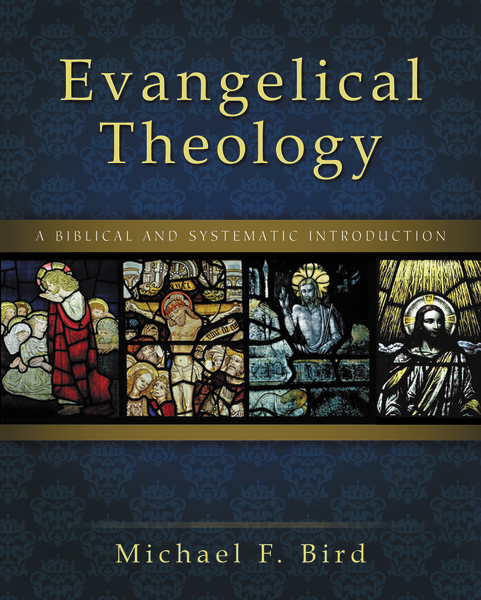
 I’ve been browsing around a review pdf of Michael Bird’s Evangelical Theology, (Zondervan, 2013), a 800pg plus ‘Biblical And Systematic Introduction’.
The review pdf doesn’t list page numbers in the table of comments and has no index, making it a nuisance to navigate a work of this size. It’s one of the reasons why I’m not providing any sort of in-depth review, but rather this notice which I’m styling ‘an appreciation’. Another reason is that there are reviews appearing by people who are far more qualified than me to evaluate a work of this scope.
Michael describes himself as an ex-Baptist, post-Presbyterian Anglican, and the book is styled Evangelical Theology because its focus is on the evangel, the good news. My feeling is, that given Michael’s self-description, it is fair to say the work is at once substantial and scholarly, while also serving as an insight into where he currently is in his studies, and as a disciple of Jesus. This is not the summary of a completed career of scholarship, but a (substantial) marker post in a life’s work that is still very much in progress.
The book demonstrates the author’s capacity to engage and assimilate a daunting breadth of scholarship and then lay out and teach his own conclusions with a deft and engaging touch. (Along with some affectionate humour.) Yet clarity is never sacrificed to demonstrate cleverness. Much of the content comes across as conversational in tone, while footnotes and further reading lists provide the means to explore avenues of thought provoked by each chapter’s content. For me personally, located well away from formal centres of theological study (both by distance and circumstance) this is one of the reasons why I appreciate works of this type: they provide, in substantial form, an understanding of what’s going on in contemporary theological studies.
Bird’s doctrinal understanding is calvinist and reformed, but not confessional, though various confessional forms are referenced in the work. It will prove interesting to see how the author’s theological trajectory will develop in subjects like the sacraments and ecclesiology, particularly as some streams of evangelical thought seem to be moving to identify congregations and denominations as boats from which evangelists fish.
I intend to purchase a paper copy in due course.
For those who subscribe to a reformed confessional position, Evangelical Theology is an up to the moment survey of where current biblical studies are interacting with those standards. Bird seems to fairly and charitably sum up the varying theological perspectives he summarises and engages with, while also managing to express his own conclusions irenically and positively. It is written by someone who has substantial skill as an accumulator and systematiser of theology and Scriptural teaching (and is based in Australia), and who affirms an affinity with reformed theological positions. It is also helpful to have a consideration of the subjects dealt with therein that is not primarily framed through the lens of North American experience and controversy, but, rather, instead brings insights from these to bear at relevant points in the work. As a systematic theology written by an Australian (a first?), no parochialism is needed to affirm it as a world-class effort.
In non-denominational settings Evangelical Theology will find use as a text, while in denominational ones it will serve as a very useful supplement to systematic and biblical theology studies.

 mgpcpastor's blog