
Last year I attended the ANZAC Dawn Service in Dili.
This is a piece that I adapted from my blog post for the day for submission to the local newspaper. The blog post has a few different details and more personal insights, for those who are interested.
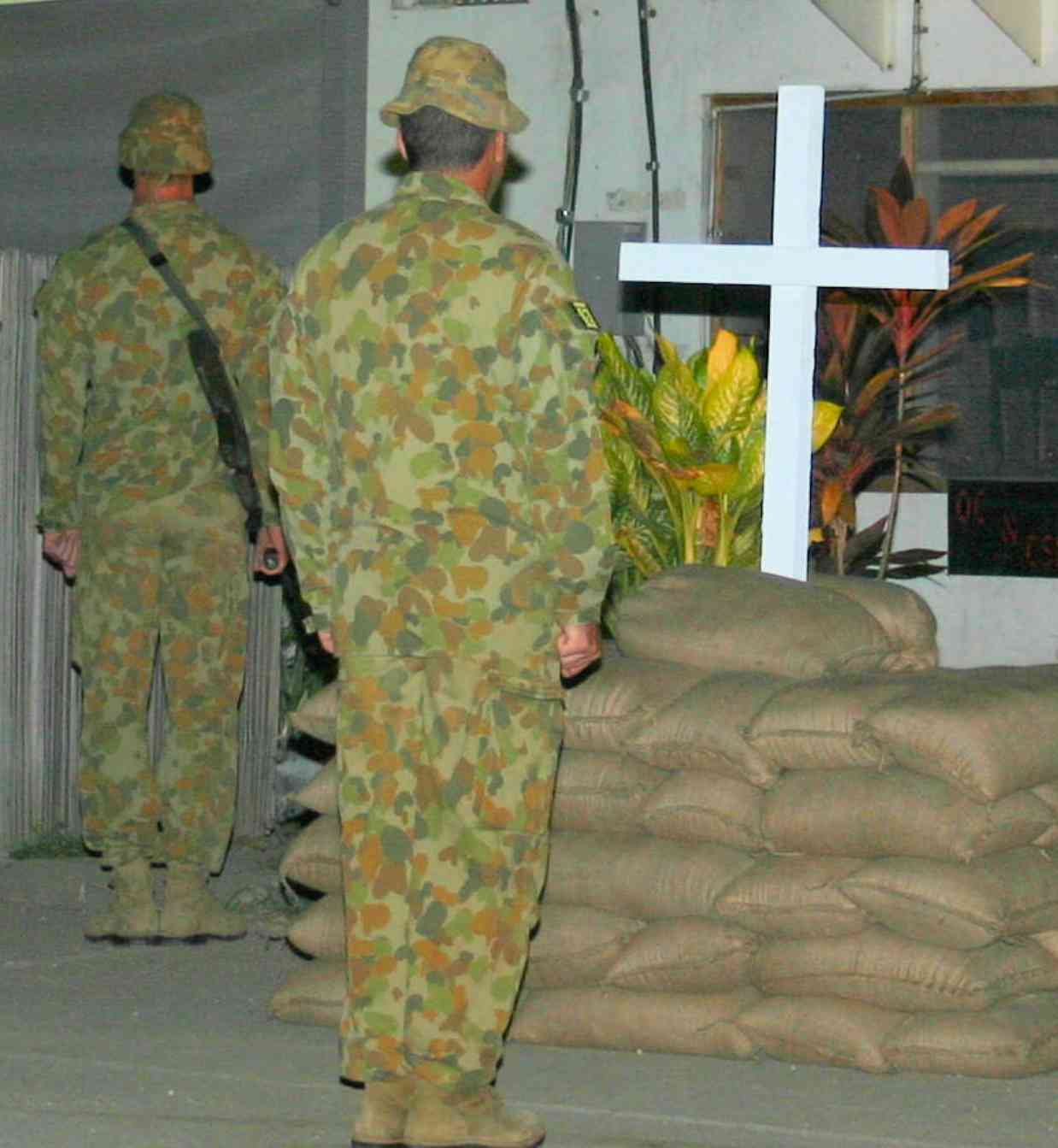
(photo by Rob Duncanson, edited by me so no-one’s face is showing)
The only resemblance between ANZAC Day in Dili and ANZAC Day in Mount Gambier is the darkness. We have arisen early, on this the last morning of our visit to Timor Leste. At 9.00am we will be flying to Darwin, but first we will join with the combined Service contingent at Dili for their Dawn Service at 5.45am.
We have made this connection through a young Serviceman who is part of the Darwin Presbyterian Church, Rob Duncanson, his pastor, is my companion. Already the humidity brings small beads of perspiration to the brow. We wake a sleeping taxi driver and ask to go to the heliport. The streets are deserted, save for early morning joggers and walkers. A few traders prepare for the day. Motoring along the road toward the airport we notice some helicopters a block away, behind a building. A quick tap on the shoulder of the driver and some words of clarification result in an about turn and prompt arrival.
We are welcomed with a familiar accent and told that early breakfast is being served. This is a ‘gunfire breakfast’. The aroma of Bundaberg Rum is prominent. The lore of the ‘gunfire breakfast’ is that consumption of alcohol settled the nerves before combat. Though there is no threat of combat this morning, those present embrace the tradition with gusto. Foam cups with a (generous) shot of rum sit out on tables. Nescafé coffee sachets and hot water are added. Milk is optional. Sometimes it looks more like rum with a shot of coffee. The presence of a large can of Milo just looks odd, but at least noone is spooning that into their rum. I embrace the tradition; Rob makes his coffee in an empty cup.
Everyone gathers in the driveway area in front of the company office. As mentioned earlier, the Service is being observed by Australians and New Zealanders. It probably counts as the most ‘ANZAC’ ANZAC Day Service I’ve been to. It is also the first time I have been privileged to be present at its being conducted in an active military environment. We stand before the two flags of our nations, both hanging at half-mast. A modest white wooden cross is planted in a catafalque of sandbags.
The Service is printed out in full. Service personnel, including Chaplains, read the parts. Before we commence, a reading from the writings of C.E.W. Bean, the noted World War 1 historian is read. Many would know that Bean’s prose, in no small part, was instrumental in the ANZAC legend becoming embedded in the national consciousness. The catafalque party takes their place.
Those of you who have attended these Services in other places would find the order and the elements familiar. That commonality of language and structure helps unite the individual commemorations with a larger whole. Familiar hymns such as: ‘O God Our Help’; and ‘Eternal Father, Strong to Save’ are absent: there is no singing.
I appreciate the simplicity of the language, but also the depth of meaning which is present. Part of what was called ‘The Serviceman’s Prayer’ was read to us by a New Zealander, and contained these words: ‘When I am inclined to doubt, strengthen my faith. When I am tempted to sin, help me to resist. When I fail, give me the courage to try again. Guide me with the light of your truth, and keep before me the example of Jesus, in whose name I pray. Amen.’ The prayer for peace asked: ‘It is our prayer this ANZAC Day that the suffering inflicted by men on men may cease, and that all people will turn to the only source of peace, which is found in the Lord Jesus Christ.’ These words show great insight into the Christian faith, and I am encouraged by their use.
The Odes of New Zealand and Australia are recited and then the ‘Last Post’ is played. At this Service we stand for a full minute’s silence; the only irreverence is displayed by a particularly noisy cricket. As ‘Rouse’ is played the flags are raised high. Only two wreaths are laid, they represent the tribute of both groups of Service personnel.
The familiar words of the twenty third Psalm are read with an accent that is reminiscent of the Pacific Islands, and after a benediction we listen to the national anthems of NZ and OZ. Later in conversation my companion (originally from New Zealand) will mention that playing ‘God Defend New Zealand’ and ‘Advance Australia Fair’ back to back is unfair to one of the anthems. I grudgingly acknowledge his point.
After the Catafalque party dismount, and the flags return to half mast, the assembled company is invited to the mess for a proper breakfast and ‘traditional games’. Even Rex, the Army Dog goes along too. He will probably be the only one not out of pocket by the conclusion of the festivities.
We talk to the young Serviceman afterward, expressing our appreciation for being able to be present. His wife and the rest of the church await his return to Darwin.
As daylight now quickly sends the night shadows into retreat, we go on our way thankful that the themes of sacrifice and service which are woven into the Service continue to be so well reflected in our Armed Services. We are also thankful for the encouragement that these people are able to take from the Christian message which has been so well affirmed during the time we have been able to spend together.
 mgpcpastor's blog