
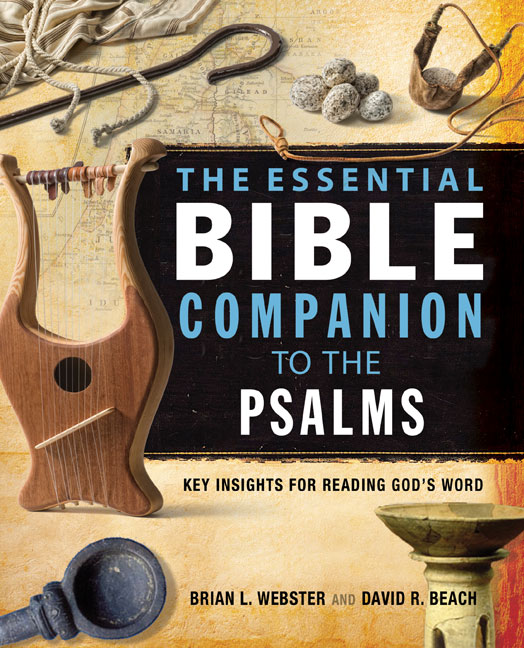
Zondervan’s ‘The Essential Bible Companion To The Psalms’ is subtitled ‘Key Insights For Reading God’s Word.’
 The volume is well laid out, with a brief introductory section providing background information about the structure of the collected Psalms, dealing with types, authorship, themes and usages. Then each Psalm is dealt with on one page under the headings of theme; type; author; background; structure; special notes; and reflection.
Obviously this means that Psalm 119 and Psalm 133 are dealt with in the same amount of space, which is, in itself, an interesting contextualisation, but demonstrates the authors’ commitment to providing an introduction to, and overview of, each psalm and not an exhaustive examination.
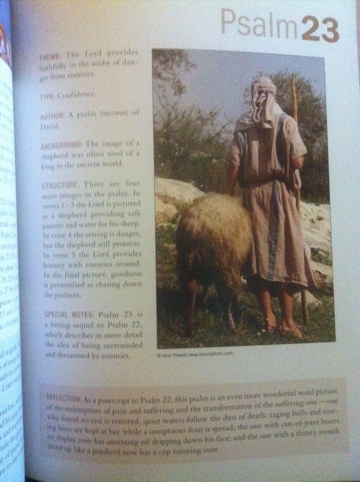 The layout is inviting and the use of larger fonts, full colour and stock photos all seem part of an intent to engage the reader. It should be observed that the stock photos are themselves a commentary on the theme of the Psalms they accompany and it would be interesting to know if the authors were involved in their choosing or if this was left to Zondervan.
But there seems to be a major problem with this book. When you include the word ‘essential’ in the title it could be taken a couple of ways: one is that the authors (Brian Webster and David Beach) have distilled study of the Psalms down to an irreducible form, or the other is that the book is a comprehensive study of the Psalms, collectively and individually. Now, obviously, the book is not meant to be the final word, or every word, but it does present itself as a ‘done in one’ companion.
Trouble is, however you wish to understand this book as an ‘essential’ companion to the psalms, a key component to understanding the Psalms is curiously absent. I say curiously because on the back cover blurb we’re told that the book provides information about “the various types of Psalms (messianic, prophetic, etc.)” while the book itself makes no reference to messianic Psalms in any meaningful way. I don’t recall reading the term in the book at all. To be fair, the term ‘royal’ is used, but it is more generally inclusive of Psalms to do with ‘the coronation of the king, God’s covenant with the line of David, or the royal wedding, or being a prayer made for the king by the whole community.’ (pg 17)
Applications of Psalms such as 22 or 110 mention that the New Testament looks back on their words in identification, but don’t engage with the idea that the words actually anticipate and find fulfillment in the person and life of the Lord Jesus. Promises in the Psalms seem applied to the immediate context of David and his generations and we are then invited to trust in the God who was faithful to them when we endure similar circumstances, just like Jesus did.
It’s because of this oversight that I’m reluctant to recommend the book. Together with other reference materials its insights are a useful supplement, there are many interesting and accessible observations contained within it. But as a starting point, or ‘essential’ companion, it is sadly lacking an essential point of reference to understanding the Psalms: messianic expectation.
(The copy of The Essential Bible Companion To The Psalms on which this review was based was provided by Zondervan as part of a blog tour to mark its publication.)
 mgpcpastor's blog