
No, we haven’t started business this early, the concluding item of business for Tuesday’s sitting was the report of the Presbyterian Inland Mission. 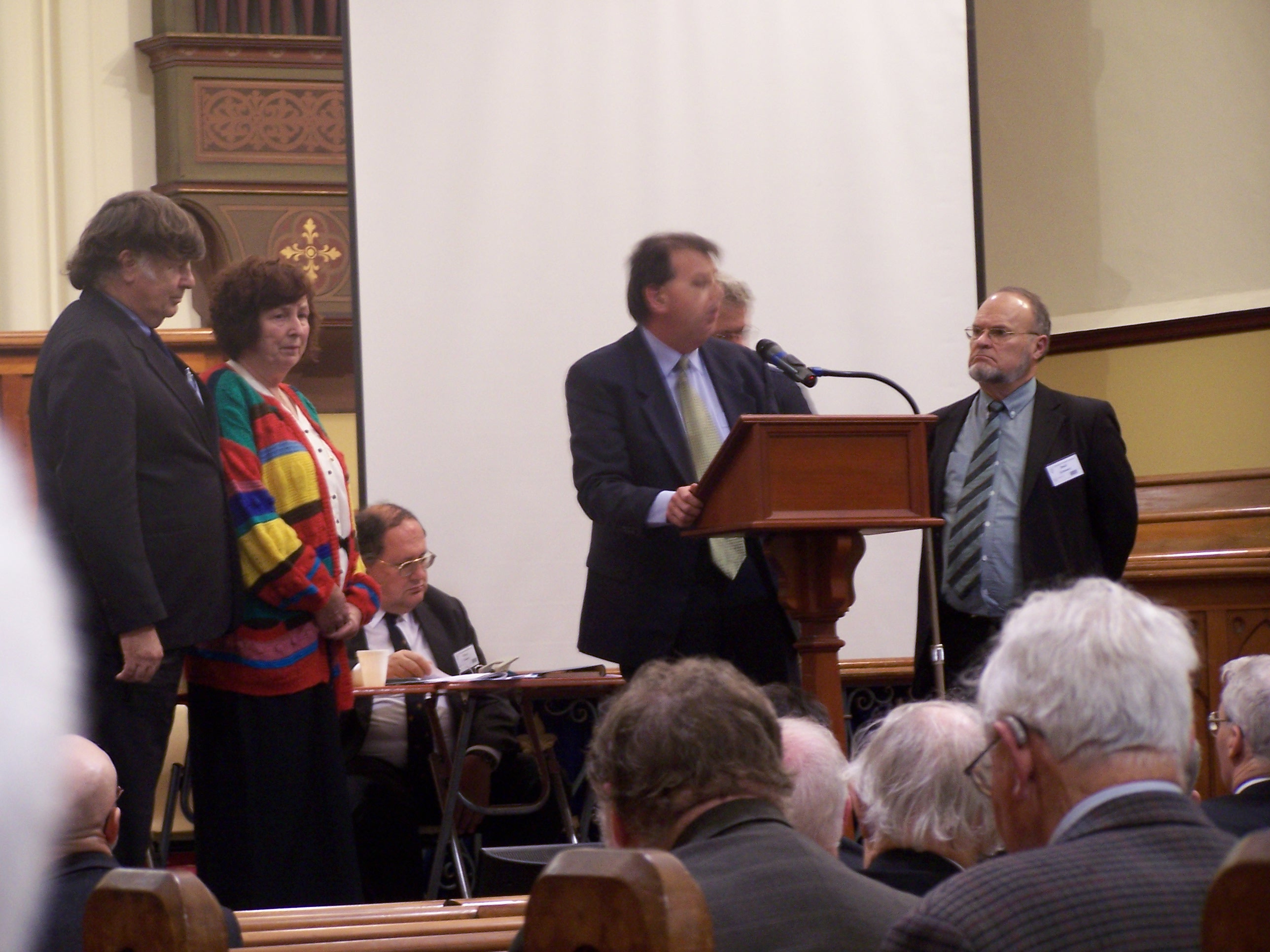 I would have liked there to be more time for this item of business, but the hour was late and the PIM had submitted a most comprehensive report in print.
(I’ll investigate if all the reports to which I’m referring will ever be posted online at some point in time.)
What is the Presbyterian Inland Mission?
From their website:
The Presbyterian Inland Mission (PIM) is the successor ministry in the Presbyterian Church of Australia to the Australian Inland Mission founded in 1912 with the Rev. Dr John Flynn as its first Superintendent.
The PIM is a ministry of the Presbyterian Church of Australia and has an expanding network of patrol ministries in Western Australia, South Australia, New South Wales, Queensland, Victoria, Tasmania & the Northern Territory.
The PIM is also involved in a growing range of caring/Philanthropic/community assistance activities – including the provision of relief to assist with the impact of drought, isolation, suffering and medical emergencies. These ministries and activities are offered freely to all and any of the people of the great Outback and Inland of the Commonwealth of Australia, in the name of Jesus Christ the Lord.
For many who live within the ever expanding ministry areas of the PIM, life continues to be very hard indeed. This makes the labour of the patrol teams of the PIM more and more demanding but also increasingly important, as by the power of the Holy Spirit they touch a growing number of people with Christian love.
Some highpoints, from those listed in the report:
Appropriately gifted patrol padres (field workers) have been identified and set apart into the various patrols.
New patrols have been declared and are being progressively staffed.
The work of the PIM is now active in all Australian states and the Northern Territory. (See the map on the front page of their website to see the location and coverage of our nation which this entails.)
A mission church in Darwin continues to grow and a mission church in Albany has been transferred into the fellowship of churches in Western Australia.
Funding continues to flow in from across Australia.
The GFC has not had a seriously adverse impact on the finances of the ministry.
Of the seventeen listed patrols and associated ministries ten are currently staffed.
The establishment of more mission churches in remote towns in Western Australia and the Northern Territory is an aspiration of the PIM.
Other comments I noted from the supporting speeches given by Stuart Bonnington and Rob Duncanson.
Triennial retreat conducted over the last week.
This is a rare opportunity for the patrol padres to meet one another, which facilitates teamwork and mutual encouragement.
Over $45,000 from the PWA of NSW was received for the purchase of a camper-trailer. Many other expressions of support have been received.
2011 calendars have been produced at the cost of $15.00 each. A DVD has been produced for free distribution.
The PIM requires ongoing financial support, investment income having decreased over the last few years.
The one hundredth anniversary of the PIM will occur in 2012, with plans already being made for appropriate celebrations.
Rudi Schwartz (part time padre with the Mallee Patrol) adressed the house, and spoke of the need which people in the outback have for the Gospel. He estimates that 90% of the people he encounters have never held a Bible in their own hands. Of lesser concern, many are unaware of the continuing existence of the Presbyterian Church.
The PIM is the Presbyterian Church’s practical, ongoing expression of concern for those who live ‘beyond the farthest fences’, the majority of whom will never be part of our denomination, but whom, by God’s grace may be part of the Kingdom. Though the ‘mantle of safety’ that Rev. John Flynn sought for the outback has been partially realised there is still much to do in practically bringing the Gospel to their front gates.
 mgpcpastor's blog